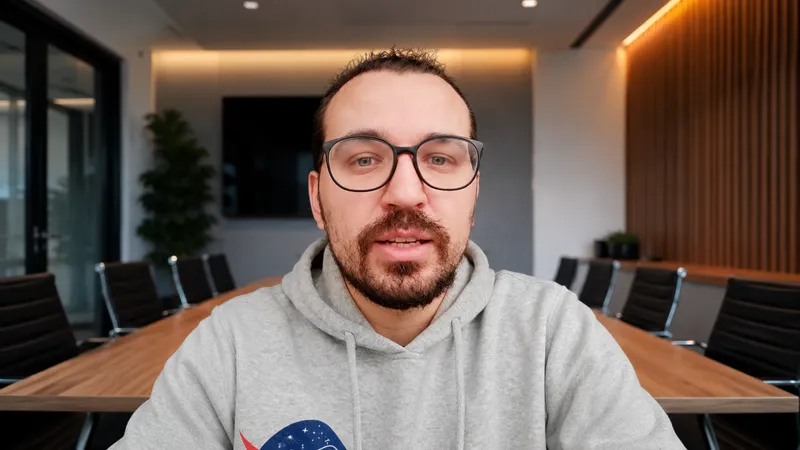
Stocks to Tokenized Real Estate: A Private Investor's Pivot


Mario is a private investor who has moved capital between traditional asset classes for years — listed equities, government bonds, occasional venture exposure. His Binaryx position is his first tokenized real estate allocation. This article is anchored to his video testimonial; specific portfolio data should be confirmed with him before publication.
Editorial note: Mario's quotes below are conceptual placeholders shaped from the homepage video testimonial. Replace with verbatim lines after a follow-up interview. Stats are placeholders pending dashboard pull.
Mario’s video review
Investor profile
"I've spent twenty years in traditional markets. Tokenized real estate gave me something equities couldn't: a property I could see, a cap table I could read, and a yield denominated in dollars rather than basis points."
| Metric | Value (placeholder — verify) |
|---|---|
| Number of invested projects | TBD — confirm with investor |
| Average APR (across portfolio) | TBD |
| Total return to date | Cumulative USDT TBD — verify against dashboard |
| Status on platform | TBD |
Why move from public markets into tokenized real estate
Mario's allocation question wasn't "is this a good asset class?" — it was "where does this fit between my equity and bond sleeves?" His answer treats tokenized property as a third bucket: less correlated with the S&P than stocks, with cash yield closer to a high-grade corporate bond, plus an upside component construction-phase positions don't get from fixed income.
What gap in your portfolio did Binaryx fill?
"Bonds were yielding too little to justify the duration risk; equities were the only thing earning real return, which made me concentrated. I wanted a third bucket — something with cash yield, low correlation to the index, and underlying assets I could actually see. Tokenized Bali real estate hit all three. Operating properties pay daily dividends. The properties exist — I've seen the photos and the operator reports. And Bali tourism is uncorrelated to US tech earnings, which is what was driving most of my equity P&L."
Why not direct ownership of a Bali property?
"Capital and operational drag. Buying a unit outright would have meant six figures, an Indonesian legal structure, an operator I'd have to vet alone, and a property I'd own for years whether or not it kept performing. Tokenized fractional ownership solves all four. I committed less capital, the Wyoming DAO LLC structure is jurisdictionally familiar, the operator is shared across token holders, and I can exit on the P2P market if my thesis changes."
What gave you pause?
"The novelty risk. Tokenization is real but young — the market hasn't been through a full property cycle on Polygon yet. What got me comfortable was the absence of clever financial engineering. Each token represents a fraction of one specific property, with a cap table you can verify on-chain. No leverage, no derivatives, no synthetic exposure. KYC was a one-time step — compliance friction that signals the platform takes its regulatory wrapper seriously rather than a red flag."
Software and tools for cross-asset investors
Mario integrates his Binaryx position into the same monitoring stack he uses for equities and bonds. The Binaryx Portfolio view shows him dividend USDT and unrealised value per property; he exports the monthly statement and imports the numbers into the same spreadsheet he uses for his overall asset allocation review. The per-minute accrual is interesting once a month — he doesn't watch it intra-day.
Off-platform, he pairs Binaryx data with the same news inputs he uses for macro: Bloomberg for Asia-Pacific tourism, the Indonesian Statistics Bureau for occupancy and inflation, and the IMF Article IV reviews for currency and rate context. Polygon settlement matters to him operationally — funding and dividend cycles are measured in minutes rather than the multi-day settlement of his bond portfolio — but he treats the on-chain layer as plumbing, not a reason to invest.
Free financial consultation with Binaryx
Earn up to ~12% real returns in your portfolio with our financial advisor and personalised strategies.
Other resources to learn how to invest
If you're approaching tokenized real estate from a public-markets background, these three resources translate the asset class into language you already use.
- Tokenized vs Traditional Real Estate in 2025 — side-by-side comparison of structure, liquidity, and yield.
- RWA Market 2026: Tokenization on Track for $10T — institutional sizing of the broader RWA opportunity.
- Is Real Estate a Liquid Asset? — the cost of illiquidity in traditional real estate vs the tokenized exit.
Conclusion
Mario's case is the cleanest version of a portfolio diversification thesis: tokenized property as a bucket between equities and bonds, sized as a single-digit percentage of overall capital, sourced from one platform with a familiar legal wrapper. He didn't need to fall in love with Bali to commit; he needed the position to do something his equity and bond sleeves couldn't.
"I needed a third bucket. This filled it."
If you're managing an allocation where stocks and bonds are doing most of the work, tokenized real estate is a credible candidate for a satellite position. The right starting question isn't "how much can this return?" — it's "what is it diversifying against?" If your equity book is concentrated in US tech earnings, Bali rental yield is genuinely uncorrelated. The Wyoming DAO LLC wrapper and Polygon settlement turn that diversification into a position you can size, monitor, and exit with the same discipline as any line in your existing portfolio.
Practical next step: size the position at 2–5% of investable capital, pick one operating rental rather than a construction-phase project for your first allocation (cash yield is what tests the operational thesis), and review it on the same cadence you review your bond sleeve — quarterly, not weekly.
Book a Binaryx consultation to talk through how a tokenized real estate position fits into a multi-asset portfolio, or attend the next webinar for a live property walkthrough.