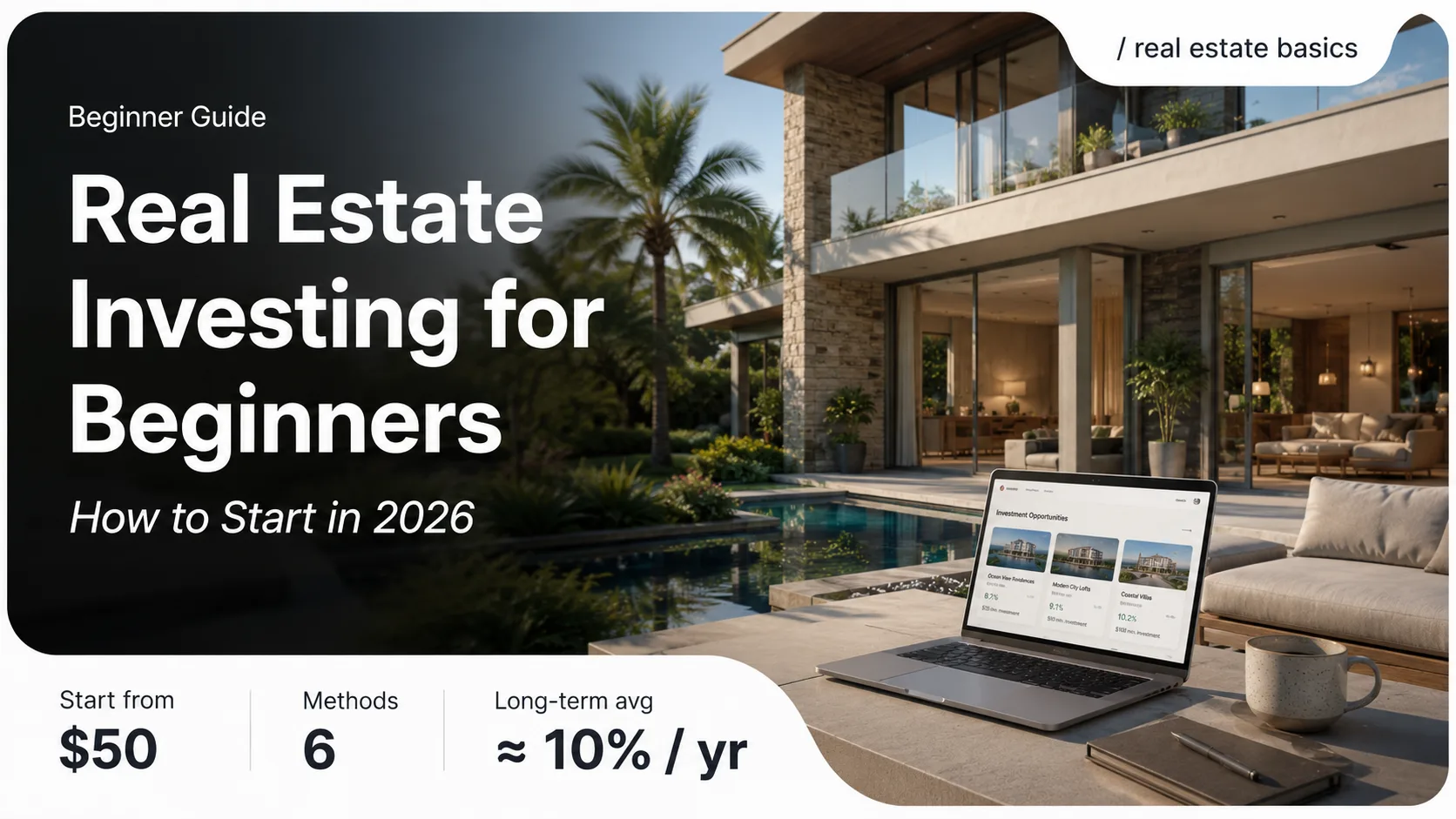
Real Estate Investing for Beginners: How to Start in 2026 (From $50)

You've probably heard that "90% of millionaires made their fortune in real estate." It's a great line. It's also mostly a myth. The real figure is closer to 10%, according to wealth researcher Thomas Stanley (Nasdaq, 2024). Most millionaires build wealth through business ownership and stocks. Property usually plays a supporting role.
So why start at all? Because real estate still does something few assets do: it pays you rent every month while it grows in value, and it shields your money from inflation. And here's the part nobody told your parents: you no longer need a six-figure deposit. Today a beginner can own a share of a rented villa for $50.
This guide breaks down the six most beginner-friendly ways to invest in real estate, ranked by how little you need to start. We'll compare real returns, honest risks, and the exact minimum to enter each one. No jargon. No hype.
Quick Summary
You don't need a mortgage or $100,000 to begin. REIT ETFs start at $1, and fractional or tokenized property starts at $50 with monthly rent payouts. The "90% of millionaires" claim is a myth: the real number is about 10% (Thomas Stanley). But property still averages roughly 10% a year over the long run. Match the method to your budget, start small, and diversify as you learn.
Disclosure: Binaryx is a fractional property platform. This is educational content, not financial advice. We weigh honest pros and cons for every method, including the ones that compete with us.
What Is Real Estate Investing (and the Truth About "90% of Millionaires")?
Real estate investing means putting money into property to earn a return: through rent, dividends, price growth, or all three. Despite the famous quote, only about 10% of millionaires made their wealth primarily in real estate (Nasdaq, 2024). So treat it as one strong pillar of a portfolio, not a magic shortcut.
Here's what the data actually shows. Roughly 68% of millionaires own two or more properties, but that's ownership, not the source of their first million. For the average American household, securities make up about 37% of net worth, real estate and mortgages around 30%, and pensions and insurance close to 19%. Property matters. It just isn't the whole story.
Why does it still belong in almost every serious portfolio? Three reasons. It's tangible, because people always need somewhere to live. It hedges inflation, because rents and values tend to rise with the cost of living. And it pays you while you wait, unlike gold or most growth stocks.
For a plain-English primer on the income side of this, see our guide to passive income from real estate. Now let's get to the methods.
The 6 Best Ways for Beginners to Invest in Real Estate
The best real estate investment for a beginner is the one that matches your budget and effort. For most newcomers, that's REIT ETFs (from $1) or fractional and tokenized property (from $50). Both pay income with zero landlord work. The chart below ranks the six main methods by how little you need to start.
1. REITs and REIT ETFs ($1+). A REIT is a company that owns income-producing buildings; you buy shares like any stock. Dividends typically run 3-5% a year (Nareit). It's the simplest, most liquid entry point, but you don't choose the buildings, and shares move with the stock market.
2. Fractional ownership ($50+). You own a share of one specific, named property and collect a slice of its rent. Unlike a REIT, you know the exact address. Returns on Binaryx listings average 8-12% APR from rent, plus any price growth. Read the deeper explainer on fractional real estate investing.
3. Tokenized real estate ($50+). Same idea as fractional, but your share is a blockchain token, so it can trade 24/7 and pay out automatically. Curious how it works under the hood? See what real estate tokenization is.
4. Crowdfunding ($500+). You pool money with others to fund a specific project. CrowdStreet investors have backed over 620 deals at a historical 18.3% IRR, though individual outcomes ranged from -100% to +116.7% (CrowdStreet). Higher potential, lower liquidity.
5. Rental property with a manager ($30,000+). The classic route: buy a home, hire a manager, collect rent. Strong combined returns, but you'll usually need a 20-25% down payment, so it's rarely a true beginner's first move.
6. Syndications ($25,000+). You join a sponsor's large commercial deal as a passive partner. Solid tax perks, but most require accredited-investor status, which puts them out of reach for new investors.
How to Start Investing in Real Estate With Little or No Money
You can start real estate investing with very little money: REIT ETFs cost as little as $1, and fractional or tokenized shares start at $50. That's the single biggest change of the last decade. A barrier that once meant tens of thousands of dollars now means the price of a dinner out.
Here's a simple ladder by budget. $50-$100: buy a fractional or tokenized share and watch your first rent payment land. $100-$500: add a REIT ETF so your money spans dozens of buildings. $500-$5,000: try a crowdfunding deal you actually believe in. The point is to begin, learn how payouts work, then scale.
Our data: On Binaryx, more than 2,400 investors have put in over $8.3 million, earning an average annualized rent yield of 11.04%, with a minimum entry of just $50. Proof you don't need deep pockets to own income-producing property.
If "no money down" is your goal, be honest with yourself: truly zero-dollar real estate usually means house hacking or heavy borrowing, both of which carry real risk. Starting with $50 of your own money in a rented property is simpler, safer, and teaches you the same lessons. For more on this, see our guide to investing with little money.
How Much Money Do You Need? Is $5,000 Enough?
Yes, $5,000 is more than enough to start, and even $50 will do. The amount you need depends entirely on the method, not on some fixed "minimum to invest in real estate." With $5,000 you could spread across fractional shares, a REIT ETF, and a crowdfunding deal all at once. The table below shows what each budget unlocks.
| Your budget | What it unlocks | Typical yield | Effort |
|---|---|---|---|
| $50 – $100 | Fractional & tokenized shares | 8–12% APR | Fully hands-off |
| $100 – $500 | + REIT ETFs (broad exposure) | ~8% total | Fully hands-off |
| $500 – $5,000 | + Crowdfunding deals | 6–12% | Fully hands-off |
| $5,000 – $25,000 | + Non-traded REITs, larger positions | 7–10% | Fully hands-off |
| $25,000+ | + Syndications, rental down payments | 8–12% | Semi-passive |
Notice the pattern: you don't need more money to get started, only to unlock more options. A beginner with $50 and a beginner with $50,000 can both own income-producing real estate today. The gap between them is choice, not access.
How to Start Investing in Real Estate: 5 Steps
Starting is more about sequence than capital. Pick a goal, set a budget, choose one method, open an account, and start small enough that mistakes stay cheap. Most beginners overthink step one and skip the only step that matters: actually beginning.
1. Define your goal. Monthly income, long-term growth, or both? Income points you toward rent-paying fractional shares and REITs; growth points toward appreciation-heavy markets.
2. Set a starting budget you won't miss. Use money you can leave invested for a few years. Never invest rent or emergency savings.
3. Choose one method. For a true beginner, fractional or tokenized property is the gentlest start: low minimum, monthly payouts, no management.
4. Open an account and verify. Reputable platforms ask for ID and a quick compliance check. That's a good sign, not a red flag.
5. Start small, then track. Buy one position. Watch a full payout cycle. Once you understand it, add a second method to diversify. Want a fuller walkthrough? Our REIT explainer is a friendly next read.
Beginner Rules Worth Knowing (3-3-3, 1%, and 50%)
A few simple rules help beginners sanity-check a deal in seconds. The 3-3-3 rule, the 1% rule, and the 50% rule each give you a quick gut-check before you commit. None is gospel, but together they keep you from obvious mistakes.
The 3-3-3 rule. A common beginner version says to study for three months, save three months of expenses as a buffer, and review your portfolio every three months. It's about pacing, not panic: slow, steady, and reviewed.
The 1% rule. Monthly rent should be at least 1% of a property's price. A $200,000 home should rent for about $2,000 a month to cash-flow well. Below that, the math gets tight.
The 50% rule. Assume roughly half of rental income disappears into expenses: taxes, insurance, maintenance, vacancies. With fractional and tokenized shares, the platform absorbs most of this, which is why net yields stay simple to read.
5 Beginner Mistakes to Avoid
Most beginner losses come from a handful of avoidable errors, not bad luck. Over-borrowing, skipping due diligence, ignoring liquidity, chasing the highest yield, and putting everything in one place cause the majority of first-year regrets. Dodge these five and you're ahead of most.
Over-borrowing. Borrowing to the hilt magnifies losses as fast as gains. Mortgage rates are still above 6% in 2026, so debt-free methods like REITs and fractional shares are gentler for beginners.
Skipping the homework. Read the fees, the legal structure, and the track record before you commit. A platform that hides these is telling you something.
Forgetting liquidity. Crowdfunding and syndications can lock your cash for 5-10 years. Keep a healthy share of your money in things you can sell within days.
Chasing the biggest number. A "20% return" with a -100% downside is not better than a steady 10%. Weigh risk, not just headline yield.
Betting it all on one deal. Spread across methods and locations. A beginner portfolio might mix a Bali fractional share, a REIT ETF, and one crowdfunding deal. See our picks for the best places to invest.
Best Books and Free Resources for Beginners
If you learn best by reading, a few classics cover the fundamentals better than most courses. They're cheap, evergreen, and written by people who actually invested. Pair them with free tools and you have a full starter education for under $100.
Four beginner favorites: The Millionaire Real Estate Investor by Gary Keller, The Book on Rental Property Investing by Brandon Turner, Rich Dad Poor Dad by Robert Kiyosaki for mindset, and The ABCs of Real Estate Investing by Ken McElroy. Read one, apply one idea, then move on. Knowledge without a first position is just trivia.
For free resources, public platforms let you compare real, current yields without spending anything, the fastest way to turn book theory into a feel for actual numbers.
Frequently Asked Questions
What is the best real estate investment for a beginner?
For most beginners, fractional or tokenized property is the best start: you can begin from $50, collect monthly rent, and skip the down payment and management of owning outright. REIT ETFs are another low-cost, fully liquid option from $1. Match the method to your budget, start small, and diversify as you learn.
Is $5,000 enough to invest in real estate?
Easily. With $5,000 you can spread across fractional shares ($50+ each), a REIT ETF, and a crowdfunding deal at once. You don't need a fixed minimum to invest in real estate. Even $50 buys an income-producing share. More money simply unlocks more options, not access itself.
What is the 3-3-3 rule in real estate?
A common beginner version says: study for three months, keep three months of expenses as a buffer, and review your portfolio every three months. It's a pacing guide, not a strict law, designed to keep new investors steady, prepared, and regularly checking that their strategy still fits.
Do 90% of millionaires really invest in real estate?
No, that's a myth often misattributed to Andrew Carnegie. Wealth researcher Thomas Stanley found only about 10% of millionaires built wealth primarily through real estate (Nasdaq, 2024). Most got rich through business ownership. Property is a reliable wealth-builder and diversifier, not a guaranteed shortcut.
Can you earn passive income from real estate without being a landlord?
Yes. REITs, fractional ownership, tokenized property, crowdfunding, and syndications all pay income with zero management. You never meet a tenant or fix a faucet. Only direct rentals require hands-on work, and even those can be handed to a property manager for a fee.
Start Small, Start Now
Real estate investing for beginners has never been simpler or cheaper. You don't need a mortgage, a landlord's patience, or the "90% of millionaires" myth. You need $50, a clear goal, and the discipline to start small and diversify. The math has worked for a century. The only thing that's changed is the price of admission.
Pick one method that fits your budget. Watch a full payout cycle. Then add a second. That's how a beginner becomes an investor: one small, real position at a time.
Ready to begin? Browse beginner-friendly properties on Binaryx from $50, or open a free account and make your first position today. Prefer to read more first? Start with our guide to passive income from real estate.
This article is educational and not financial advice. Past performance doesn't guarantee future results. All investments carry risk, including possible loss of principal. Talk to a qualified advisor before making portfolio decisions.