Glamping Investment in Europe 2026: What the Data Says and How to Get In
The glamping market grew up. The investment infrastructure didn't — until now.
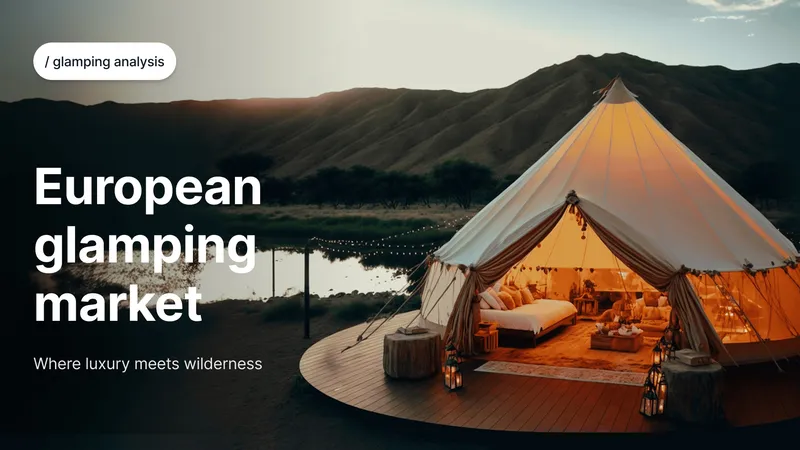
The European glamping market has reached USD 1.28 billion (2024) and is projected to grow at 8.5% CAGR to approximately USD 2.17 billion by 2030. What started as luxury tents for Instagram has become a real hospitality asset class — with institutional capital flowing in and occupancy rates that most hotel operators would envy.
We've been building toward this moment. Over 2,400 investors on the Binaryx platform have collectively committed $8M+ into tokenized real estate across Bali, Turkey, and Montenegro. Some of those investments went exactly as projected. Others hit construction delays, management gaps, and the kind of friction that doesn't make it into pitch decks. Now we're applying everything we've learned — what worked, what didn't, and what investors actually need — to glamping as the next asset class on the platform. This guide reflects that experience: the market opportunity, the real risks, and why we believe glamping is where tokenized real estate goes next.
One of our early investors put it simply: "10–15% returns I consider normal — that's what made this interesting compared to what the stock market was offering." That's the conversation happening right now — not "should I invest in glamping?" but "how does this compare to what I already hold?"
Here's the honest comparison
Before we go deeper, this is the context most investors actually want — glamping stacked against familiar alternatives:
| Asset class | Projected annual return | Liquidity | Entry threshold | Key risk |
|---|---|---|---|---|
| S&P 500 ETF | ~10% (historical avg) | High (daily trading) | $1+ | Market volatility, no income until sale |
| Bank deposit (EU) | 2–4% | High (instant access) | $1+ | Below inflation in most years |
| Direct real estate | 4–8% rental + appreciation | Very low (months to sell) | €100K–€1M+ | Illiquid, management-intensive |
| REITs | 4–8% dividend | High (stock exchange) | $100+ | Correlated with equity markets |
| Glamping (tokenized) | ~8–15% projected | Medium (P2P 24/7) | $500 | Operator quality, occupancy variance |
A note on honesty: glamping returns are projected, not guaranteed. For context, the mid-market reality across Europe looks like this: average nightly rates run €150–€300 per unit, annual occupancy averages 40–60% (peaking above 68% in high season in mature markets like the UK), and net profit margins for well-run sites typically land between 20–40%. Payback periods range from 3 to 5 years depending on location and scale. The 8–15% projected yield in our model reflects conservative 60–70% occupancy assumptions — not best-case scenarios. Actual results depend on property performance, operator execution, and market conditions. And for comparison, the S&P 500's ~10% is a long-term average that includes years where investors lost 30%+.
This guide breaks down how glamping investment actually works, what the return range looks like in practice, and how tokenization is making it accessible to people who don't have €200K to buy a property outright.
The Market You're Looking At
Understanding where the money is flowing — and why — matters before you commit capital to anything.
European glamping at a glance
| Metric | Value |
|---|---|
| Market size (2024) | USD 1.28 billion |
| Projected size (2030) | USD 2.17 billion |
| CAGR (2024–2030) | 8.5% |
| Dominant format | Cabins & pods (45.3% share) |
| Fastest-growing segment | Luxury glamping Europe (premium pods, treehouses) |
| Key demand demographic | 18–32 years (41.7% of demand) |
Here's the shift that changed everything: glamping moved from seasonal canvas tents to permanent, architect-designed structures — cabins, pods, glass lodges. That single transition turned a summer novelty into a year-round hospitality product. And year-round means year-round cash flow — which is what turns glamping from a lifestyle play into a serious investment.
To put this in perspective, here's how the top European glamping markets compare:
| Country | Market Size / CAGR | Tourism Arrivals | Entry Cost | Competition |
|---|---|---|---|---|
| UK | $359M / 10.7% | 40.9M | High | Very High |
| France | $115M / 11.8% | 100M+ | Medium-High | High |
| Croatia | ~12%+ CAGR | 21.3M | Medium | Medium |
| Italy | ~9% CAGR | ~65M | High | High |
| Scandinavia | ~10% CAGR | 45M+ (NO+SE) | High | Low-Medium |
| Montenegro | First-mover | 2.6M | Low | Very Low |
The pattern is clear: mature markets (UK, France, Italy) offer stability but high entry costs and saturated competition. Montenegro offers the opposite — lowest entry cost, lowest competition, and structural tailwinds that none of the mature markets have.
How Glamping Investment Works: 3 Models, Very Different Experiences
Not all glamping investments look the same. The model you choose determines your capital commitment, your level of involvement, and — frankly — how well you sleep at night.
1. Direct Ownership (Buy & Operate)
You buy the land. You build or buy the structures. You manage everything — or hire someone to do it.
| Pros | Cons |
|---|---|
| Full control over operations | High entry threshold (€200K–€1M+) |
| 100% of income | Operational complexity and time commitment |
| Potential capital appreciation | Illiquid — hard to sell quickly |
| Requires local market expertise |
Typical returns: 6–12% gross yield (varies dramatically by location, occupancy, and whether your management company actually answers the phone)
2. Real Estate Crowdfunding (Equity/Debt Pools)
You invest through a crowdfunding platform that pools capital from multiple investors into glamping developments. You get distributions proportional to your share.
| Pros | Cons |
|---|---|
| Lower entry threshold (€1K–€10K) | Limited transparency on specific assets |
| Passive — no operational burden | Platform risk (if platform fails, so does your investment) |
| Diversification across projects | Often no secondary market — your capital is locked |
| Regulatory varies by jurisdiction |
Typical returns: 5–10% annually (debt) or 8–15% (equity, with higher variance)
3. Fractional Ownership via Tokenization — This Is What We Built
Here's where things get interesting. Real estate tokenization issues blockchain tokens representing fractional ownership in a specific property. Each token is your share of the rental income — when guests book a night, you earn proportional to what you hold. And tokens can be traded on a secondary market, 24/7.
| Pros | Cons |
|---|---|
| Low entry threshold ($500–$1,000) | Relatively new — limited long-term track record |
| On-chain transparency (smart contracts) | Requires KYC and basic crypto wallet familiarity |
| 24/7 secondary market liquidity | Regulatory landscape still evolving |
| Specific property exposure (not pooled) | Token value tied to underlying asset performance |
| Automated distributions |
Typical returns: ~8–15% annually (projected, property-dependent), plus potential secondary market appreciation
We built Binaryx around this model because we believe it changes who gets to participate in real estate. It’s a compromise between a tent and a hotel, without the crowds. It’s a place where tourists can recharge their batteries and take a break from the big cities and offices, which are gradually returning to their daily routines. Tokenization means an investor in Kyiv or London could own a verified fraction of a glamping property for $500 — with every transaction recorded on Polygon blockchain.
Until now, Binaryx has tokenized residential buildings and apartments across three countries. Glamping is a different category entirely: hospitality, seasonality, operator dependency. It's a completely new asset class for the platform — and we're approaching it with everything we've learned from 37+ tokenized properties and 2,700+ investors. Our first glamping project — Glamping Dukley — is coming, and we'll share all the details, numbers, and due diligence in the next article. Create an account on Binaryx so you don't miss it.
One of our existing investors put it well: "What attracted me was that even if the investment doesn't work out, you don't risk everything. You can start small and see how it works." That mindset — start small, verify, then scale — is exactly how we think every new asset class should be approached.
A word about secondary market liquidity
"24/7 P2P trading" means the market is always open — but it doesn't mean instant execution at any price. Like any secondary market, liquidity depends on active buyers and sellers. For larger positions, you may need to price competitively and wait for a match. On Binaryx, the average time to sell has been days, not weeks — but this varies by property and conditions. There's a 2% Binaryx commission on sales, and buyers receive a 3% discount on the listed price.
What Makes a Good Glamping Investment? 6 Things We Look At
Whether you're buying direct, going through a crowdfunding platform, or investing in tokenized real estate — the same fundamentals separate good opportunities from speculative ones. These are the seven criteria our due diligence team applies to every property we evaluate.
1. Year-round demand — not just summer
Single-season glamping sites face 4–6 months of zero revenue. That's not a business model; it's a gamble on weather. The best investments operate in dual-season or year-round markets — mountain destinations with winter ski + summer adventure, or Mediterranean sites with extended shoulder seasons.
2. An operator you'd trust with your own money
A glamping investment is only as good as the people running it. We look for management companies with verifiable hospitality experience, Booking.com/Airbnb ratings of 9.0+, and existing operating properties you can actually check. This is the single biggest risk factor we've identified — and the one most investors underweight.
3. Cash flow coverage that actually works (DSCR)
Does the project generate enough cash flow to cover investor obligations with breathing room? A DSCR of 120%+ means the project earns $1.20 for every $1 it needs to pay out. Below 100% means it can't cover obligations from operations alone — and that's a red flag.
4. Freehold, not leasehold
Freehold ownership (land + structures) gives you maximum security. Leasehold introduces expiry risk and caps your upside on appreciation.
5. Macro tailwinds working in your favor
Is the location benefiting from structural demand growth? EU accession catalysts, new air routes, highway infrastructure, and tourism policy support are what we look for. Montenegro, for example, has all four simultaneously — and that's not an accident.
6. How you get out
This is the question most people forget to ask until they need the answer. Direct ownership requires finding a buyer. Crowdfunding typically locks you in for 3–5 years. Tokenized real estate offers 24/7 P2P secondary market trading — a genuine liquidity advantage, though execution speed depends on market depth.
Why Montenegro? Because the Timing Is Rare
If you're going to invest in glamping, location matters as much as the structure. Montenegro isn't just a good market on paper — it's a country in the middle of a transformation that creates a narrow window for early investors.
The thesis, in plain terms
EU accession is happening. 13 of 33 chapters provisionally closed (January 2026), with targeted membership by 2028. When Croatia and Slovenia joined the EU, property prices jumped 30–40%. Montenegro is on the same path — and prices haven't moved yet.
Mountain tourism is structurally underbuilt. Of Montenegro's 15.6 million overnight stays (2024), 93.8% are concentrated on the coast. Mountain resorts account for just 2.2% — despite dual-season demand from ski and adventure tourism. There is currently no institutional-quality glamping complex operating in Montenegro's mountain region. When supply is this low relative to demand, pricing power belongs to whoever builds first.
Air connectivity is about to explode. Wizz Air is opening a Podgorica base in 2026 with 14+ new European routes and ~1 million additional annual seats. More flights = more tourists = higher occupancy.
This is exactly the kind of market where tokenized glamping can thrive — and it's why Montenegro is where our first glamping project, Glamping Dukley, is located. All the details — pricing, projected returns, due diligence — will be in the next article. Explore the Binaryx platform to stay informed.
What about diversification beyond one country?
Montenegro is where the strongest tailwinds converge right now. But concentrating everything in one market is never wise — the same principle that applies to stocks applies here. The Binaryx platform also hosts tokenized properties in Bali (established rental market with proven booking history) and Turkey (high-growth tourism with lower entry prices). Spreading across geographies is the simplest risk reduction move you can make.
For the broader Montenegro thesis, read our Montenegro Real Estate 2026: Why Investors Are Moving Now.
How Tokenization Changed Who Gets to Invest in Real Estate
Historically, investing in glamping meant you needed €300K and a local lawyer. We thought: what if you needed $500 and a phone?
That's not a marketing line — it's the actual design principle behind real estate tokenization. Here's what it changes:
Fractional access — real estate for the rest of us
Instead of a six-figure commitment, tokenized real estate lets you start from $500–$1,000. That makes glamping investment a portfolio diversification tool rather than an all-in bet — and it means you can test the asset class before scaling.
On-chain transparency — because "trust us" isn't enough
Smart contracts define income distribution rules, ownership percentages, and payout schedules. Every transaction is recorded on Polygon blockchain — not because blockchain is trendy, but because it means any investor can verify any distribution, transaction, or ownership split directly on-chain. No phone calls. No "it's in process." Just data.
Secondary market — your money isn't trapped
Unlike crowdfunding platforms with multi-year lock-ups, tokenized real estate can be traded 24/7 on P2P secondary markets. You're not waiting years for a fund to liquidate. You list, you price, the market finds the match.
Binaryx operates under a Wyoming DAO LLC structure (US law jurisdiction). Smart contracts are audited by Blaize (9.8/10 security score). All investors complete KYC verification under US regulatory requirements.
Explore Tokenized Real Estate Properties on Binaryx
The Risks — And We're Not Going to Sugarcoat Them
We could skip this section and make the article feel more optimistic. We'd rather you trust us.
Occupancy isn't a constant
Even in dual-season markets, occupancy fluctuates. Weather, economic cycles, new supply coming online — all of these shift the numbers. That's why we model at 60–70% baseline occupancy, not the optimistic 85%+ you'll see on some platforms. Conservative assumptions protect investors from disappointment.
Construction delays are real
New-build glamping projects can hit delays. Modular/prefabricated construction reduces this risk versus traditional builds, but it doesn't eliminate it. On Binaryx, each property page shows current construction status and projected delivery — including any updates or delays, because hiding bad news erodes trust faster than bad news itself.
Your returns depend on who manages the property
In a fully delegated model, the quality of the operator is everything. From our existing properties, we know that if a management company fails to fulfil its obligations with due diligence, profits can suffer. So now, the vetting process for management companies on the platform has become even stricter, as we want every asset we recommend to our investors to be managed in a timely, systematic and predictable manner to ensure financial results.
Tax complexity across borders
Cross-border glamping investment involves multiple jurisdictions. Binaryx's Wyoming DAO LLC structure means the entity is US-based, but you're individually responsible for tax reporting in your country of residence. Montenegro doesn't withhold tax on distributions to foreign investors through the DAO structure. EU-resident investors should consult a tax advisor on how foreign rental income is treated — in most cases it's reported as foreign-source income. We provide annual distribution statements, but this isn't tax advice. Get independent counsel.
Currency exposure
EUR-denominated properties with USD-denominated returns introduce FX risk. On Binaryx, distributions and secondary market prices are in USD. Make sure you understand the currency dynamics before investing.
How People Actually Get Started
If you're still reading, you're probably not just curious anymore. Here's what the process looks like — step by step, with the parts most people ask about.
Step 1: Browse properties (no commitment)
Go to the Binaryx property marketplace. Each property page shows location, projected return, operator, construction status, token price, and total tokens available. Look around, compare across geographies. Nothing happens until you decide it should.
Step 2: Verify your identity (KYC)
Before purchasing tokens, you'll verify your identity — passport or national ID + selfie. This isn't optional and it isn't arbitrary: it's required by US law under the Wyoming DAO LLC structure. It's the same identity verification process used by regulated brokerages and banks. Takes about 5–10 minutes, typically approved within 24 hours. Your data is encrypted under GDPR-compliant protocols.
Why does this matter? Because a platform that lets anonymous accounts buy real estate ownership tokens isn't protecting its investors. KYC is how we ensure everyone at the table is verified — which protects you as much as it protects us.
Step 3: Fund and purchase
Connect a crypto wallet (MetaMask or WalletConnect) or use the fiat on-ramp. Minimum investment: $500. Select the property and number of tokens, review the smart contract terms, confirm. Your ownership is recorded on Polygon blockchain — verifiable on-chain by anyone, including you.
Step 4: Watch your income accrue
Rental income accrues daily — calculated second-by-second, actually. Distributions are visible in your dashboard. You can track occupancy, revenue, and payout history for each property in real time. This is where on-chain transparency stops being abstract and becomes something you check on your phone.
Step 5: Hold or trade — your call
Hold for ongoing income, or list your tokens on the P2P secondary market whenever you want. You set the price. There's a 2% commission on sales, with a 3% discount passed to the buyer.
Before you commit: the practical checklist
- Know your budget and comfort zone — Can you commit €200K+ for direct ownership? Or does $20,000–$50,000 for fractional tokenized access make more sense as a starting point?
- Decide how hands-on you want to be — Manage a property yourself, or invest passively and check your dashboard once a week?
- Apply the 7 due diligence criteria above — Especially operator track record, cash flow coverage, and exit liquidity.
- Understand the legal wrapper — DAO LLC, SPV, limited partnership — they're not the same. Each has different investor protections and tax implications.
- Start small — Test the asset class with $500 before scaling. As one investor told us: "I started with $1K just to see how it all worked." That's a perfectly rational approach.
About Binaryx
Binaryx is a real estate tokenization platform — and one of the few doing this with real properties, real tenants, and real distributions. Over 2,400 investors have collectively put $8M+ into income-generating properties across Bali, Turkey, and Montenegro.
Everything runs on Polygon blockchain — not because blockchain is a buzzword, but because it means every transaction, every distribution, every ownership change is verifiable by anyone. The platform operates under a Wyoming DAO LLC structure (US law jurisdiction).