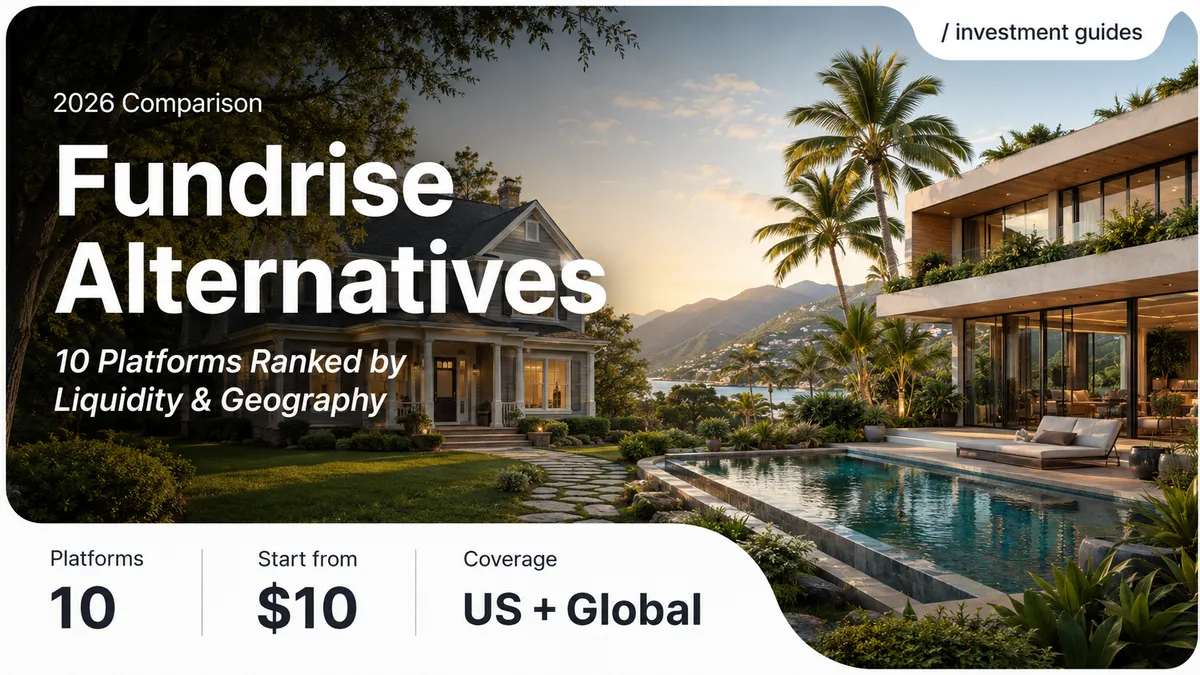
Fundrise Alternatives 2026: 10 Platforms Ranked by Liquidity & Geography

Fundrise crossed 2 million users and approximately $3.5 billion in equity under management in March 2026, making it the largest direct-to-consumer alternative investment platform in the US (Fundrise, 2026). The simple onboarding, $10 minimum, and diversified REIT-style portfolios attract retail investors who want hands-off exposure without picking individual deals.
But Fundrise's strengths cut both ways. The diversified pool model means you cannot pick which property your money funds. The 1% annual management fee compounds against your capital regardless of performance. Quarterly redemption windows constrain exits. And the entire portfolio is US-based, with no crypto rails. If you want individual property selection, lower fee drag, international exposure, faster liquidity, or USDT-denominated investment, you need to look elsewhere.
Key Takeaways
The best Fundrise alternatives in 2026 depend on what you optimize for. Binaryx leads for international diversification with crypto access (38 properties across Bali, Montenegro, Turkey, Dubai; 11.04% rental APR; 20–40 min P2P sell). Arrived ($100) and Ark7 ($20) let you pick individual US rental homes. Yieldstreet ($10K) and RealtyMogul ($5K) offer diversified commercial alternatives. CrowdStreet ($25K) covers accredited commercial CRE. Lofty.ai provides real-time Algorand tokenized liquidity. Groundfloor ($10) handles short-term debt. Stake and SmartCrowd are DFSA-regulated Dubai specialists.
Disclosure: Binaryx operates one of the platforms compared below. This article presents balanced criteria so you can pick the right platform for your goal — including those that compete with Binaryx directly. Every external claim is sourced; internal claims about Binaryx are verified against platform data as of April 2026.
What Makes a Good Fundrise Alternative?
A good Fundrise alternative wins on at least one of four dimensions: minimum investment, liquidity window, geographic scope, or crypto access. Fundrise itself wins on the lowest entry ($10) and brand recognition, but loses on individual property control, fee drag over time, exit speed, and international + crypto coverage. Most alternatives trade Fundrise's diversification ease for a different strength, so your choice should follow your goal — not a generic "best" ranking.
Here is a framing that competing articles miss. Plot every fractional real estate platform on a two-dimensional chart: liquidity on one axis (from fixed-term debt at one end to real-time secondary trading at the other), and geography on the other (from single-country to global). Fundrise sits at "US only" with quarterly redemption. Lofty sits at "US only" with real-time Algorand trading. Yieldstreet and RealtyMogul sit at "US only" with quarterly liquidity windows. Binaryx occupies the top-right quadrant alone, with four-country exposure and a 20–40 minute peer-to-peer secondary market. That empty quadrant is the market gap Fundrise cannot fill.
According to Moneywise's April 2026 comparison of fractional real estate platforms, US-focused alternatives split into three buckets: low-minimum REIT-style pools (Fundrise, Ark7, Arrived), accredited commercial CRE (CrowdStreet, RealtyMogul private placements), and tokenized blockchain platforms (Lofty, RealT) (Moneywise, 2026). Outside the US, the picture is even thinner — only a handful of platforms serve global investors, and Binaryx is the only one combining international properties with crypto-native rails.
All 10 Platforms at a Glance
Before the detailed platform breakdowns, here is the full comparison in one table. Use it as a reference while reading the sections below.
1. Binaryx: International + Crypto Access
Binaryx is the best Fundrise alternative if your goal is international property exposure paired with crypto-denominated investment. The platform currently holds 38 digitized properties across four countries (Bali, Montenegro, Turkey, and Dubai), all accessible with USDT or fiat. Fundrise concentrates entirely on US assets through diversified REIT-style funds; Binaryx gives you individual property selection across four geographies with crypto rails.
We will be upfront: Binaryx is much earlier in growth than Fundrise. Our $8.4 million in total investment is roughly 1/420th of Fundrise's $3.5 billion equity AUM. We are not the bigger platform. We are the right platform for a specific use case: investors who want exposure outside US real estate, individual property control (you pick which villa or apartment), higher rental yields than US REITs typically produce, and faster secondary market liquidity without quarterly redemption windows.
Binaryx platform metrics (verified April 2026):
- $8,393,938 total invested in tokenized real estate
- 38 active properties across Bali, Montenegro, Turkey, and Dubai
- $484,812 paid to investors in rental distributions to date
- 2,500+ registered investors
- 11.04% average annual rental income (APR)
- 17.12% average capital appreciation rate (realized on sale)
- 20–40 minutes average peer-to-peer secondary market sell time
- $500 minimum investment
- Seller-only fee model: zero fees to buy or hold, commission only on P2P sale
The fee model is the sharpest contrast with Fundrise. Fundrise charges a 1% annual management fee plus a 0.85% asset management fee on top in some funds, regardless of performance or whether you sell. Over ten years, that fee drag compounds significantly against your capital. Binaryx charges a commission only when you sell a share on the secondary market. If you hold, you pay nothing beyond the initial investment. This rewards long-term investors and keeps net rental APR closer to the gross figure.
The 11.04% rental APR figure reflects actual rental distributions across the 38 properties, not projected yield. The $484,812 already paid to investors proves the distribution model works. The 17.12% appreciation is cumulative across properties that have completed secondary market sales — realized value, not unrealized estimates. Importantly, rental yield and appreciation are separate metrics: 11% is cash in hand, 17% is the appreciation locked in when an investor sells a share.
On geography: Bali is our largest single-country portfolio, followed by Montenegro and Turkey, with Dubai as our newest expansion. These markets produce different rental yield and appreciation profiles than US suburban residential. For background on how the tokenization model works, see our guide to tokenized real estate.
Binaryx accepts global investors with no US Social Security Number or ITIN requirement. Open an account on the Binaryx app to browse the current property catalog.
2. Arrived: US Rental Homes with Individual Selection
Arrived is the most direct Fundrise alternative for US-based investors who want to pick individual rental homes rather than buy into a diversified pool. The platform crossed 945,000 investors and $337 million AUM in February 2026 across 536+ properties in 66 US markets (FinanceBuzz, 2026). The $100 minimum keeps the entry low while letting you see each property's pro forma, location, and projected yield before investing.
The key difference with Fundrise: Arrived sells you fractional shares of specific single-family rentals and vacation properties. Fundrise gives you exposure to a diversified pool. If you want to research the market, the neighborhood, and the specific home, Arrived fits better. If you want to "just put money in and let it grow," Fundrise's auto-diversified model is easier.
Liquidity used to favor Fundrise (quarterly redemption vs Arrived's hold-to-sale model), but Arrived launched a secondary market in 2025. Volume is still building. Distributions are quarterly, similar to Fundrise. Fees are baked into property pricing rather than charged annually — different optics than Fundrise's transparent 1% but harder to estimate over a full hold period.
Pick Arrived if you want US single-family rentals with property-level control and a $100 entry. Pick Binaryx if you want the same property-level control but applied to international markets with crypto rails. For a head-to-head with all 10 platforms beyond Arrived, see our Arrived Homes alternatives comparison.
3. Ark7: US Properties + Monthly Income
Ark7 sits between Fundrise and Arrived structurally: a $20 minimum with individual property selection and monthly distributions (more frequent than Fundrise's quarterly cadence), per Ark7's platform overview. The portfolio averaged 4.36% annualized dividend yield in 2026, with top-performing properties yielding up to 6.89%.
The one-year holding period is the friction: you cannot sell before the lockup ends. After year one, shares trade on Ark7's secondary market, though volume is thinner than blockchain-native tokenized platforms. Property management is handled by Ark7's partners, so you are not the landlord.
Ark7 distinguishes from Fundrise on two axes: lower entry ($20 vs Fundrise's $10 but with property control), monthly cash flow (vs quarterly), and individual property selection. The trade-offs are smaller portfolio diversification per dollar and the 1-year lock.
Pick Ark7 if you want US property-level control with monthly income and you can wait a year before any exit. Pick Binaryx if you want faster secondary liquidity and international geography.
4. Yieldstreet: Diversified Alternatives with $10K Minimum
Yieldstreet is the closest direct Fundrise competitor in concept: a diversified alternative investment platform spanning real estate, private credit, and art rather than picking individual deals. The Alternative Income Fund opened to non-accredited investors with a $10,000 minimum and charges a 1% annual management fee plus 0.5% admin expense (Yieldstreet, 2026). The fund targeted a 7.1% net annualized yield through December 2024.
Differences from Fundrise: Yieldstreet's $10K entry is much higher than Fundrise's $10, putting it out of reach for first-time alternative investors. The fund spans more asset classes than Fundrise's real-estate-focused portfolios. Withdrawals are quarterly, similar to Fundrise but with stricter capacity limits. The platform also offers individual deal access for accredited investors at higher minimums ($25K+) — that side requires accreditation.
Pick Yieldstreet if you have $10K+ to allocate and want diversified alternatives beyond pure real estate, with a hands-off pool structure. Pick Fundrise if you want lower entry. Pick Binaryx if you want international real estate with crypto rails and individual property control.
5. CrowdStreet: Commercial CRE for Accredited Investors
CrowdStreet is the largest direct commercial real estate investment platform for accredited investors, with over $3.16 billion committed across 620+ deals and a historical IRR of 18.3% — though individual deal outcomes range widely from total loss to 116.7%+ returns (CrowdStreet Marketplace Performance). The $25,000 minimum and accredited-only access put CrowdStreet in a different category from Fundrise.
CrowdStreet is direct deal access: you back specific commercial properties (office, multifamily, industrial) developed by sponsors. Fundrise pools your money into REIT-style portfolios. CrowdStreet's hold periods run 5–10 years with no secondary market — illiquid by design. Sponsors take performance fees plus platform fees on top.
CrowdStreet matters as a Fundrise alternative for accredited investors looking to graduate from diversified pools to project-level commercial deals. The higher minimum and longer hold are the cost of that control and access to institutional-grade buildings.
Pick CrowdStreet if you are accredited, have $25K+ per deal to allocate, can hold for 5–10 years, and want direct sponsor relationships in commercial CRE. Pick Fundrise if you are non-accredited or want simpler diversified exposure. Pick Binaryx if you want shorter liquidity windows in international tokenized properties.
6. RealtyMogul: Commercial REITs + Private Placements
RealtyMogul bridges Fundrise and CrowdStreet: it offers commercial REITs accessible to non-accredited investors at a $5,000 minimum, plus accredited-only individual deal placements at $25K-50K+ minimums. The platform focuses on commercial real estate — office, multifamily, retail, industrial — that Fundrise also covers but with a more REIT-focused structure.
Fees on the REIT side run roughly 1–1.5% annually, similar to Fundrise's range. Liquidity is quarterly redemption with limits. The non-accredited REIT options target 6–8% net annualized yields with monthly or quarterly distributions. The private placement side is accredited-only, illiquid (3-7 year hold), with higher target yields (8-12%+).
RealtyMogul matters as a Fundrise alternative when you want commercial CRE exposure specifically (vs Fundrise's mixed residential + commercial mix) and you have $5K+ rather than Fundrise's $10. The accredited side opens commercial direct deals at a lower per-deal minimum than CrowdStreet.
Pick RealtyMogul if you want commercial-focused REIT exposure at $5K+ minimum, or accredited commercial direct deals at $25K-50K. Pick Fundrise if you want lower entry. Pick Binaryx if international + crypto rails matter more than US commercial coverage.
7. Groundfloor: Short-Term Debt
Groundfloor takes a different approach from every other platform in this list. Instead of equity ownership, you invest in real estate loans to property flippers and renovators, with terms of 6 to 24 months and historical returns averaging around 10% gross (CreditDonkey, 2025). The $10 minimum matches Fundrise's lowest entry.
Because you are lending rather than owning, the risk profile shifts. If a borrower defaults, Groundfloor forecloses, and you may recover less than your investment. In exchange, you avoid rental vacancy risk, property management headaches, and the unpredictability of long-term equity investing.
Liquidity is a fixed term: capital is locked until the loan is repaid (typically 6–12 months for most flips). No secondary market. Compared to Fundrise's quarterly redemption windows, Groundfloor's 6-month natural exit is actually faster on average — but you cannot exit early at all.
Pick Groundfloor if you want short-duration debt exposure without vacancy risk. Pick Fundrise if you want diversified equity exposure with quarterly liquidity. Pick Binaryx for equity-style fractional ownership with faster P2P exit.
8. Lofty.ai: Tokenized US Liquidity
Lofty.ai is the closest direct comparison to Binaryx in terms of blockchain architecture but focused entirely on US single-family rentals. Each property is tokenized on the Algorand blockchain, and shares trade on Lofty's secondary market in near real-time (Lofty, 2025). The $50 minimum is low, and there is no holding period requirement.
Liquidity is Lofty's biggest differentiator against Fundrise. Where Fundrise constrains exits to quarterly redemption windows with 1% early withdrawal penalties in the first five years, Lofty's Algorand-based marketplace lets you sell shares any time. For investors who value exit optionality, this is a structural advantage.
The constraints are geographic and chain-specific. US single-family only, Algorand tokenization only. If you use Ethereum or USDT on other chains, you will bridge or convert. For RWA-token context, see our overview of RWA platforms.
Pick Lofty if maximum liquidity in US tokenized real estate matters and Algorand fits your crypto stack. Pick Binaryx if you want international geography or multi-chain rails.
Dubai-Specific Alternatives
If Dubai specifically is your target market, two DFSA-regulated platforms specialize there. They are worth a section of their own because Dubai is the second-largest fractional real estate market after the US — and Fundrise gives you zero Dubai exposure.
9. Stake (getstake.com)
Stake is the largest Dubai-focused fractional real estate platform, with over 600 properties funded since 2021 and regulation by the Dubai Financial Services Authority (DFSA) (Stake, 2026). The minimum is AED 500 (~$136 USD), and DFSA regulation is the strongest framework any platform in this list holds outside Fundrise's SEC oversight.
Stake covers Dubai and Saudi Arabia, splits between residential and short-term rental properties, and runs a secondary market for share trading. Fees follow Dubai industry norms: entry fee (1.5–2%), annual admin (~0.5%), exit fee (up to 2.5%). More total fee drag than Binaryx's seller-only model but with stronger investor protections than most Web3-native platforms.
Pick Stake if Dubai-only exposure with DFSA regulation is your priority. Pick Binaryx if you want Dubai as part of a four-country portfolio (Bali, Montenegro, Turkey, Dubai) with crypto-denominated investment.
10. SmartCrowd
SmartCrowd is Dubai's first regulated fractional real estate platform, established in 2017 and registered with DIFC under DFSA supervision. The AED 500 minimum matches Stake. SmartCrowd's strength is institutional credibility and the longest track record among Dubai platforms.
The trade-off is smaller inventory and thinner secondary market volume than Stake. If you evaluate Dubai platforms on regulatory stability and operating history rather than breadth, SmartCrowd deserves comparison.
Pick SmartCrowd for a conservative, regulated-first Dubai entry. Pick Stake for breadth. Pick Binaryx for Dubai within a multi-country portfolio with crypto rails.
Combined Rental + Appreciation Yield Comparison
Annual returns differ widely across these platforms. The chart below shows combined annualized yield (rental income + capital appreciation) at the midpoint of each platform's reported range. Where appreciation is unrealized or not reported separately, only rental yield is shown.
Fundrise's blended ~8% target sits in the middle. Platforms with individual property selection and risk concentration (CrowdStreet, Binaryx) reach higher zones with proportionally higher per-deal risk. Ark7's 2026 dividend yield of 4.36% reflects the difficult US single-family rental environment of recent quarters. Binaryx's combined 28.16% (11.04% rental + 17.12% appreciation) reflects realized performance on properties that completed secondary market sales, not projections.
How to Choose the Right Alternative
No single platform wins on every axis. The right choice depends on which trade-off you accept. Use this decision framework to narrow down based on goal rather than feature count.
From operating Binaryx's secondary market, we have observed that investors leaving Fundrise tend to do so for two distinct reasons. The first cohort wants individual property control — they pick Arrived or Ark7. The second cohort wants international exposure or crypto rails — they end up at Binaryx, Stake, or Lofty depending on their geographic focus. Investors who stay on Fundrise typically value the auto-diversification and brand recognition; that is a real benefit, and we do not pretend otherwise. The point of an alternatives comparison is to clarify what tradeoff you are making by choosing one model over the other.
If international diversification drives your decision, Binaryx remains the only alternative in this list with four-country exposure. For a focus on Bali specifically — our most popular single market — see our guide to invest in Bali real estate.
Frequently Asked Questions
What is the best alternative to Fundrise for individual property selection?
Arrived ($100 minimum, US single-family) and Ark7 ($20 minimum, US single-family with monthly distributions) are the closest direct fractional alternatives that let you pick individual properties rather than buy into a diversified pool. Both are non-accredited and US-focused. For international property selection with the same individual-control model, Binaryx covers Bali, Montenegro, Turkey, and Dubai.
What is the cheapest alternative to Fundrise?
Groundfloor matches Fundrise's $10 minimum entry, but with a different product (debt instead of equity). Ark7 starts at $20 with property control. Lofty.ai starts at $50 with tokenized US single-family. For investors with more capital, Yieldstreet's $10K minimum and CrowdStreet's $25K minimum target higher-yield diversified or commercial deals.
Which Fundrise alternative has lower fees?
Fundrise charges approximately 1% annual management plus 0.85% asset management in some funds. Binaryx charges only a seller-only commission on P2P secondary sales — zero fees to buy or hold. Groundfloor charges no fees to investors at all (revenue from borrower side). Lofty.ai charges per-transaction (~3%) instead of annually. Over a 10-year hold, the difference compounds significantly.
Can I invest internationally outside the US through a Fundrise alternative?
Yes. Binaryx offers tokenized real estate across Bali, Montenegro, Turkey, and Dubai — the only platform in this list with multi-country international coverage. Stake and SmartCrowd are Dubai-focused. Every other major Fundrise alternative (Arrived, Ark7, Yieldstreet, CrowdStreet, RealtyMogul, Lofty, RealT, Groundfloor) is US-only.
Which Fundrise alternative supports crypto-denominated investment?
Binaryx accepts USDT alongside fiat and operates on multiple blockchains for international properties. Lofty.ai tokenizes US single-family on Algorand. RealT tokenizes US single-family on Ethereum and xDai. Binaryx is the only crypto-native platform with international property exposure — the others are US-only.
Is Fundrise better than Arrived?
Neither is better in absolute terms — they target different investor profiles. Fundrise is simpler and lower-entry, with diversified pool exposure. Arrived requires more research (you pick individual properties) but gives transparency on each home. Fundrise has more total AUM and longer track record; Arrived has property-level pro formas and a growing secondary market. The right choice depends on whether you want hands-off auto-diversification (Fundrise) or individual property control (Arrived).
Final Word
Fundrise is a good fit for US-based investors who want hands-off diversified real estate exposure at the lowest possible entry. For everyone outside that specific profile, better alternatives exist. International investors should look at Binaryx. US investors wanting individual property control should pick Arrived or Ark7. Accredited investors targeting commercial CRE should consider CrowdStreet or RealtyMogul. Investors prioritizing liquidity should consider Lofty.ai or Binaryx's P2P market. Investors wanting short-term debt should choose Groundfloor. Dubai-focused investors should compare Stake and SmartCrowd alongside Binaryx's Dubai inventory.
The four-dimension framework (minimum, liquidity, geography, crypto access) outperforms generic "best" rankings because it forces an explicit trade-off. No single platform wins every axis. Start by naming your priority, then pick the alternative that optimizes for it.
Read more:
- Arrived Homes Alternatives 2026: 10 Platforms Ranked by Liquidity & Geography — companion BOFU article covering the same 10-platform matrix from the Arrived perspective
- Fractional Real Estate Investing: 2026 Complete Guide — what fractional real estate means, how share splits work, and why it changed the entry point for retail investors
- Passive Income Real Estate: 6 Proven Ways to Start in 2026 — broader survey covering REITs, crowdfunding, fractional ownership, syndications, and tokenized assets
- Best Countries to Invest in Real Estate in 2026 — country-by-country analysis covering yields, regulations, and access for international investors
This article is for educational purposes only and does not constitute financial advice. Past performance does not guarantee future results. All positions carry risk, including potential loss of principal. Consult a qualified financial advisor before making investment decisions.